For operations managers in professional services, external hiring is a familiar tool. Whether you work in IT, accounting, consulting, or technical services, the dilemma remains the same. When should you use external staff, and when should you opt for other solutions?
The scenario is familiar. A client calls with an interesting project, but your current team is fully booked. Or you win a large tender but lack specialist knowledge. The reflex? Outsource. Fast, flexible, problem solved.
Yet, that automatic reflex isn’t always the best choice. Hiring external staff carries significant costs and risks that go beyond just the daily rate.
When external hiring makes sense
External hiring works well in specific situations:
Temporary peaks. Your accounting firm is in the middle of tax season, or your IT department is experiencing a short go-live that requires extra staff. Outside resources can temporarily alleviate the pressure without adding to your fixed costs.
Specialized knowledge for one-off projects. An engineering firm wins a contract that requires specific certifications, or a consultancy needs a sustainability specialist for a single project. Filling knowledge gaps that aren’t part of your core competency is a legitimate reason for external hiring.
Experimenting with new markets. Are you a technical service provider looking to explore a new field? External expertise can help you determine whether permanent expansion is worthwhile, without immediately hiring permanent staff.
Uncertain market conditions. If your revenue fluctuates or your order book is unpredictable, external staff offer flexibility. You can scale up or down without the risk of layoffs.
When to avoid external hiring
There are at least as many situations in which external hiring is counterproductive:
Structural capacity shortages. If you hire the same professionals every month, you’re not hiring temporary help, but masking a structural staffing problem. That consultant who’s been with you for eight months? You should have hired him permanently.
Knowledge development is crucial. In sectors where knowledge is valuable, organizations lose a lot by hiring externally. That expensive interim manager will soon leave with all the knowledge they’ve acquired. For accounting firms and consultancies, where client relationships and subject matter expertise are essential, this risk is significant.
Culture and continuity. Professional services revolve around team dynamics and collaborative working methods. Frequently changing external forces disrupt that continuity. Clients notice the difference between a close-knit team and a collection of changing faces.
Hidden costs pile up. Hiring external staff seems transparent, but don’t forget the training time, coordination costs, and the risk of quality differences. A permanent employee who is fully trained within three months delivers more value in the long run than three different external hires per year.
The financial reality: what do external hires really cost?
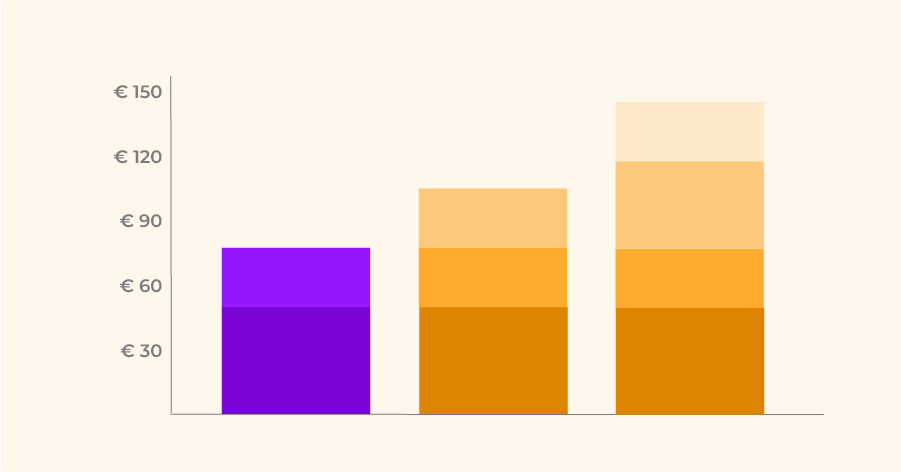
The hourly rate for an external employee seems straightforward at first glance, but the total costs are considerably higher than many managers realize. Research shows that external employees are 1.6 to 2.0 times more expensive than the salary of a comparable permanent employee. When hired through temporary employment agencies, this factor even increases to 1.8 to 2.5 times.
For short-term projects (less than a year), hiring external staff can still yield savings of 20-30%, mainly because you don’t pay holiday pay, sick pay, or employer contributions. But as soon as an external staff member stays longer than a year, the balance shifts. Then you pay the higher rates for months, while a permanent employee would have been structurally cheaper.
Secondment through intermediaries becomes even more expensive: costs rise by approximately 45% due to VAT and agency margins. According to recent research, the Dutch government pays an average of €10.50 per hour more than current market rates, simply because hiring rates remain linked to internal salary scales rather than market rates.
These figures are not unusual. In 2024, the central government spent a total of €3.7 billion on external hiring, representing 15.4% of all personnel expenditures. For municipalities, this percentage is even as high as 18%. Both far exceed the Roemer standard of a maximum of 10%.
The difference between time and material and fixed price
For professional services organizations, the type of project makes a crucial difference in how external hiring affects profitability.
With projects based on time and material, you can often pass on external costs to the client. The higher hourly rate of external contractors directly translates into a higher invoice. Although your hourly margin may be lower, the impact on the total project margin remains limited.
With fixed price projects, things are fundamentally different. Here, your internal cost price is entirely your own responsibility. Every hour an external employee works on the project costs you 1.6 to 2.5 times as much as a permanent employee. But you invoice the same project price.
Suppose your accounting firm sold a compliance assignment for €50,000. You calculated 500 hours at €60 internal cost, which yields a healthy 40% margin. But due to a capacity shortage, you hire an external consultant for 200 of those 500 hours at €120 per hour. Those 200 hours now cost €24,000 instead of €12,000. The margin drops from €20,000 to €8,000—a 60% reduction.
For IT companies and technical service providers that handle many fixed price projects, regular external hiring can mean the difference between profitability and loss-making. Every external hire that regularly participates in fixed price work directly eats into your project margins.
This makes external hiring for fixed price projects a risky strategy, unless it’s truly temporary and necessary. Structural reliance on external staff in this type of work is a warning sign that your resource planning isn’t aligned with your sales strategy.
The alternative: strategic capacity planning
The best way to limit external hiring? Avoid situations where you become dependent on it. That starts with understanding your actual capacity needs.
Many operations managers plan reactively: a project is coming, so we’ll hire people. A predictive approach works better. Analyze your project pipeline, identify patterns in your resource needs, and anticipate peak times before they occur.
This also means being honest about staffing levels. If your employees are consistently at 90% capacity, there’s no room for growth, illness, or vacation. The result? You’re forced to hire external staff at the least favorable times, often at higher rates.
Also consider internal flexibility. Can employees temporarily switch between projects or departments? Is there room for cross-training, allowing people to fulfill multiple roles? These investments reduce dependence on external parties.
Conclusion: Finding the balance
Hiring externally isn’t taboo, but it’s also not a panacea. For operations managers, it’s about making conscious choices based on specific situations, not on habit or convenience.
Before hiring, ask yourself three questions: Is this truly temporary? Are we building knowledge, or are we losing it? And are the total costs, including indirect costs, acceptable?
Organizations that approach external hiring strategically use it to supplement a stable core workforce. They invest in planning and insight, allowing them to use external staff only when it truly adds value. The result is not only cost savings but also higher quality, improved continuity, and team collaboration that makes a real difference for clients.