You know the problem: your Java developer is on the bench for two weeks because there’s no Java work, while the front-end team is screaming for extra hands. Or your best data analyst is sick and no one can cover her work. In organizations with purely specialized teams, bottlenecks, staff turnover, and vulnerable dependencies constantly arise. The solution? A T-shaped team.
What is a T-shaped professional?
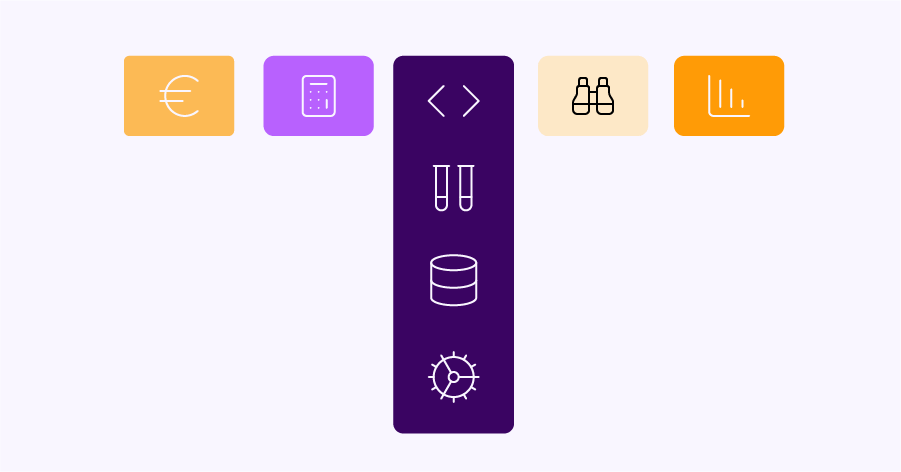
The concept of T-shaped skills was popularized in the 1980s by McKinsey & Company and later embraced by IDEO CEO Tim Brown as the ideal way to build effective, creative teams. The metaphor is simple: the vertical line of the T represents deep expertise in a single field, while the horizontal line represents broad knowledge and skills across adjacent disciplines.
For example, a T-shaped developer specializes in Python, but can also tackle front-end issues, understand database design, and contribute to architectural decisions. A T-shaped consultant has in-depth knowledge of supply chain management, but also understands enough about financial modeling and change management to assist with those projects when needed.
The difference with an I-shaped professional—someone with deep knowledge solely in one domain—is crucial. I-shaped employees are indispensable for their expertise, but they create vulnerable teams. If they are absent or unavailable, work grinds to a halt. A T-shaped team combines the best of both worlds: specialist quality and flexible deployment.
Why T-shaped teams are a game changer for resource planning
For operations managers at professional services firms—from IT consultancies to engineering firms—team composition is directly linked to utilization rates, margins, and delivery reliability. T-shaped teams offer advantages on three levels.
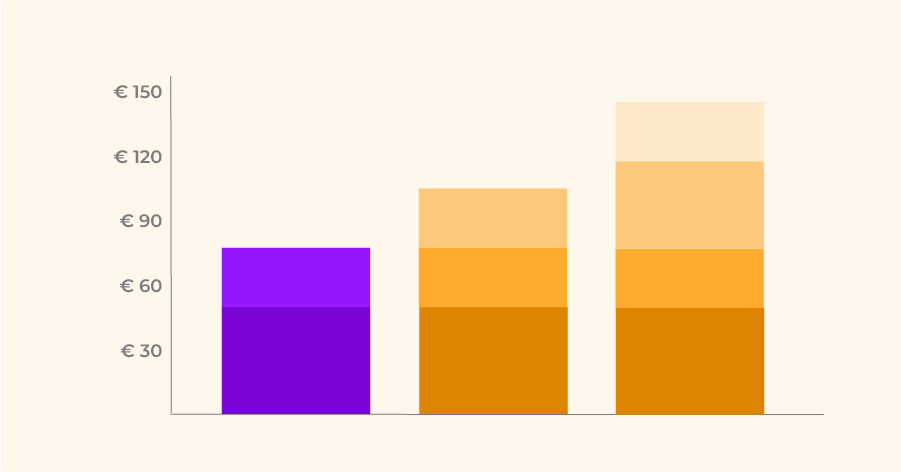
Higher and more stable utilization rates. When employees are more versatile, there’s less downtime. A consultant who can take on tasks in related projects alongside their specialty is simply more productive. Instead of waiting for just the right type of work, a T-shaped professional can step in where demand is greatest. In practice, we see that organizations with T-shaped teams can increase their utilization rates by 10 to 15 percent, simply because there’s less mismatch between supply and demand.
Less vulnerability to failure and turnover. In a team of purely specialists, the departure or illness of one person is immediately felt. Projects are delayed, clients are disappointed. When multiple team members can partially cover each other’s work, the team is more resilient. You essentially have built-in redundancy without needing additional FTEs.
Smoother project staffing. Resource planners know the challenge of having the right specialists available for every project. T-shaped teams simplify the puzzle: you have more combination options for building a project team. This means faster project start times, less reliance on external staffing, and better project balance.
Five concrete steps to building a T-shaped team
The transition from a specialized to a T-shaped team doesn’t happen overnight. It requires a conscious strategy and a culture that encourages learning and knowledge sharing. These five steps will help you get started.
1. Map the current competencies
Start with a fair inventory of your team’s competencies. For each employee, create an overview of their primary expertise (the vertical line) and their additional competencies (the horizontal line). Use a simple competency matrix: list employees on the rows, skills on the columns, and score the level of each combination. This way, you can see at a glance where the blind spots are and which competencies are only covered by one person.
2. Define the desired team T
Not every employee needs to be knowledgeable in everything. Determine which additional skills are most valuable for each role. For a back-end developer, that might be front-end knowledge, while for a project manager, it might be basic data analysis knowledge. Focus on the combinations that are most frequently needed in practice. Look at your project history: which projects experienced bottlenecks due to a lack of the right skills? These are the areas where T-shaping will have the greatest impact.
3. Create learning opportunities on the job
The most effective way to develop broad competencies isn’t through classroom training, but through hands-on learning. Organize pairwork sessions where a specialist collaborates with a colleague from a different field. Have employees rotate between projects or teams. Implement internal knowledge sessions where team members share their expertise. The key is for employees to regularly push themselves outside their comfort zone—not to turn them into generalists, but to broaden their horizons.
4. Adapt your planning to broad deployability
A T-shaped team also requires a different approach to planning. Instead of scheduling employees solely based on their primary specialty, you can also assign them to tasks that align with their secondary competencies. This requires that you record not only the primary specialty, but also the additional competencies and their corresponding level in your resource planning tool. This allows you to filter by multiple competencies when assigning employees, giving you a more complete picture of who is available and suitable for what.
5. Measure and reward development
You can’t manage what you don’t measure. Make the development of T-shaped competencies part of performance reviews and team objectives. Celebrate when an employee successfully tackles a task outside their primary expertise. Set concrete goals: for example, that every employee develops at least one additional competency to a workable level within a year.
The pitfalls to avoid
Building a T-shaped team sounds appealing, but there are pitfalls. The most significant is the risk of sacrificing specialist depth for breadth. A team of only generalists will produce lower-quality work than a team of true experts. The vertical line of the T must remain strong—the horizontal line is a complement, not a replacement.
A second pitfall is resistance from the team. Not every specialist is eager to take on tasks outside their comfort zone. Therefore, communicate clearly why you’re choosing this direction, involve employees in determining their development path, and ensure that learning happens gradually. No one needs to master a different profession overnight.
Finally, there’s the risk of overestimating someone. Just because someone has taken a basic front-end development course doesn’t make them a fully-fledged front-end developer. Be realistic about what you expect from the broad competencies and plan accordingly. A T-shaped employee can step in and support, but doesn’t always replace the specialist.
The role of resource planning software
Managing a T-shaped team is more complex than managing a purely specialized team. You have to consider more variables: not only availability and primary specialization, but also secondary competencies, experience levels, and development goals.
Good resource planning software makes this manageable by linking competencies to employees, so that when putting together project teams you can immediately see which combinations are possible.
With the right tools, you can also track your team’s T-shaped development. You’ll see which competencies are now well-represented, where gaps remain, and whether the broader deployability is actually leading to better utilization rates.
Conclusion
Building a T-shaped team isn’t a one-time project but an ongoing investment in your organization’s resilience and flexibility. By encouraging specialists to broaden their horizons—without sacrificing their depth—you create teams that are more plannable, less vulnerable to failure, and ultimately more profitable. In a market where projects are becoming increasingly diverse and competition for talent is intensifying, this isn’t a luxury but a necessity.
The first step? Grab that competency matrix and map out where your team stands now. The rest will follow naturally.