In practice, we see two extremes. On one hand, the organization where only the planner sees the planning board. The reason is almost always the same: “if everyone can see it, everyone will start discussing it.” So the planning stays behind closed doors, and every Monday the planner gets the same question: do you already know what I’m doing next week?
On the other hand, the organization that has fully opened up the planning board. Everyone sees everything — including last night’s change that wasn’t even final yet, and the fact that a colleague was just put on that interesting project. There, too, the planner gets questions every Monday. Just different ones.
Total secrecy creates a shadow schedule where people gather information from each other. Total openness creates noise about decisions that haven’t been made yet. The question, then, is not if you are transparent, but about what, with whom, and how far into the future.
Two distinctions that make the conversation easier
Facts versus considerations. Who is where and when is a fact. That can be shared broadly — it makes the organization faster. Why you put Peter on that project and not Anna is a consideration. That involves competencies, development goals, customer relationships, sometimes rates, and sometimes things you don’t want to put on a planning board at all. Considerations belong in a conversation, not in a tooltip on a planning bar.
Access versus authority. Much of the resistance to open plans isn’t actually resistance to access, but the fear that every change becomes negotiable. Those are two different things, and it helps to separate them explicitly. Viewing is a right; deciding is a role. If you state that clearly once, a large part of the objection disappears.
What you do share
- Personal short-term planning. Projects, clients, locations, absence. Everyone should be able to see what is expected of them in the coming weeks without the planner’s intervention.
- Project planning. Who is in the team, what phases are there, when does someone’s involvement start and stop. This prevents the classic situation where a project lead assumes someone is “just available.”
- Capacity bottlenecks at the team or competency level. This is where transparency pays off the most. As soon as it’s visible that three projects are asking for the same two engineers in week 42, it becomes a prioritization question for management instead of a puzzle the planner solves in silence with overtime.
- The status of the planning itself. Is this a draft, a provisional booking, or a firm appointment? This is perhaps the most important point of this whole piece. Most unrest doesn’t come from organizations sharing too much, but from sharing something provisional that is read as a promise.
What you don’t share (or share differently)
- Individual utilization percentages side-by-side. At the team level, this is management information. As an open list per person, it becomes a ranking, and then people start optimizing their own percentage instead of the work.
- Rates and margins per person, even if they weigh into the allocation.
- Pipeline that hasn’t been won yet, as a concrete booking. Do share it as a scenario, clearly labeled — otherwise people are scheduled for work that never comes.
- The reason for absence, and performance arguments behind a choice. That someone is away is planning information. Why they are away is not.
Draft and release: the button that makes this workable
This is exactly where the discussion often gets stuck in practice. Planners want to be open, but they need a workspace. You move a project by a week, see what that does to three other projects, and move half of it back. If every intermediate step is immediately visible to everyone, you stop taking those steps — or you start planning in a spreadsheet that no one else sees, alongside the resource planning tool.
What you need, therefore, is a draft mode: a working version of the planning that you don’t share with everyone. You first adjust the planning in draft and only release it when it is final. Until that moment, the team sees the last released version. No half-finished changes, no noise, and no more reason to work around your planning.
The second part is just as important: you release by time period. For example, you only release the first four weeks and keep the period after that in draft. This way, you don’t have to choose between keeping everything closed and opening everything up. You say to your team: this is firm, this is still moving.
This makes transparency a setting rather than a matter of principle. And that is necessary, because the right answer differs per industry.
How far ahead? That depends on your industry
Technical service providers. In installation, maintenance, and engineering organizations, the planning further ahead is by definition unstable. Emergency work comes in, a delivery shifts, a customer isn’t ready on site. If you release the planning for three months there, you are mostly sharing future changes. Technicians and engineers will start arranging their private lives around a schedule that changes five more times, and every change costs you a conversation. In these industries, we see a clear desire to release a maximum of a few weeks — often two to four. What comes after that is planning work, not a promise.
Professional service providers. In consultancy, accountancy, and IT projects, it’s the other way around. Someone is on the same assignment for months, sometimes a year. Releasing that commitment four weeks ahead is pointless: the information people need is actually further away. When does my current assignment end? What comes next? Can I plan that training in November? Here, a longer horizon is not a risk but a requirement — for the consultant who wants to know where they stand, and for the partner who wants to see what expertise will become available in a quarter.
Different industries, same mechanism: determine which horizon in your reality is reliable enough to be a promise, and release exactly that. For one, that’s two weeks; for another, half a year. What you especially don’t want is one standard for the whole organization while your departments work at different speeds — even within one company, the engineering department may need a shorter horizon than the consultants.
A small framework to start with
Three categories that make the conversation easier. Determine per industry how far ahead you release: what is firm enough to be a promise, you publish – the rest you keep in draft.
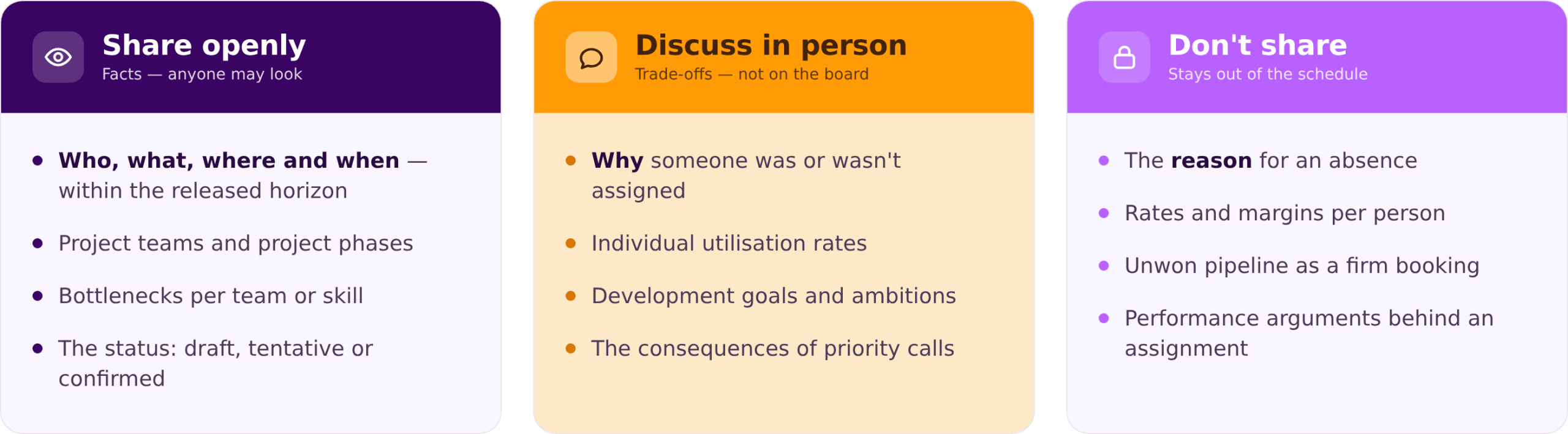
Figure 1: Framework for transparency in planning
Finally
The goal of transparency is not for people to feel they are being treated fairly. That is a pleasant byproduct. The goal is for scarcity and conflicts to become visible sooner, so you can make a decision about them instead of quietly solving them with overtime.
A good test for your own organization: if someone asks today what they are doing in three weeks, can they look it up themselves? And do they know if they can count on it?
If the answer to the first question is no, you are sharing too little. If the answer to the second question is no, you are sharing too far ahead.