In a previous article, we wrote about the T-shaped model — professionals who combine a broad foundation with one deep specialization. That model is and remains valuable. For many organizations, it is exactly the right balance between expertise and collaboration.
However, there are industries and situations where it is useful to go a step further. Where you need people who can really make a difference not in one, but in two disciplines. That is where the Pi-shaped model comes into play.
What is a Pi-shaped professional?
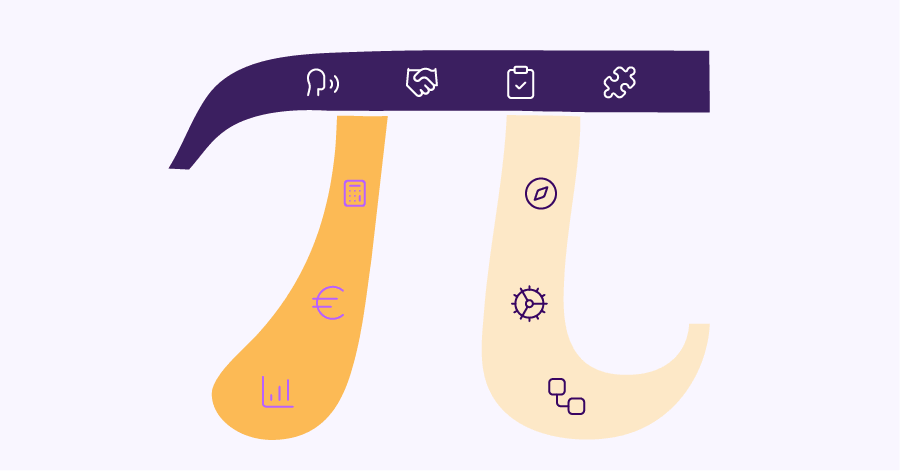
The name refers to the Greek letter π. Just like with the T-shaped model, there is a broad horizontal bar—the general knowledge and skills that enable someone to collaborate across disciplines. But where the T-model has one vertical leg, the Pi-model has two. Two deep specializations instead of one.
For example, a Pi-shaped consultant might have in-depth expertise in both financial modeling and change management. An IT professional might master both software architecture and data engineering at a high level. A marketer can be both a content strategist and a data analyst.
The crucial difference compared to a broad generalist: both pillars represent true, in-depth expertise — the level at which you can independently solve complex problems.
For which industries is the Pi model particularly suitable?
The T-shaped model works excellently in many organizations. However, there are specific sectors and work environments where the Pi model adds extra value.
Consultancy and advisory firms
In consultancy, the Pi model has long been common, even if it is not always referred to as such. Clients expect their advisors to be able to handle multiple issues simultaneously. A consultant who possesses both the substantive expertise and understands the change management side can guide a project from start to finish without the need for new specialists to join the table every time. This increases client satisfaction as well as the margin on projects.
IT and technology
In the tech sector, projects are increasingly being handled end-to-end by smaller teams. A developer with in-depth knowledge of cloud infrastructure, or a data scientist who also masters software engineering, is invaluable in such a context. This is especially true at scale-ups and medium-sized IT companies, where you cannot set up a separate team for every area.
Creative and digital agencies
At agencies that combine strategy, design, and technology, disciplines constantly overlap. A UX designer who also masters front-end development, or a strategist who can also perform high-level data analysis, fits seamlessly into the way these agencies work. The Pi-model aligns better with this than the T-model because projects rarely remain confined to a single discipline.
Engineering firms and technical consultancy organizations
Multidisciplinary issues are becoming increasingly common in technical services — think of the combination of structural design and sustainability advice, or process optimization and data analysis. Pi-shaped engineers can handle these cross-pollinations without the need to schedule a separate specialist for each sub-area.
Where the T-model suffices perfectly well
It is important to emphasize: not every organization needs Pi-shaped profiles. In environments where roles are clearly defined and projects predominantly fall within a single discipline, the T-shaped model is just right. Think of specialized research teams, production environments with clear separation of functions, or organizations where the strength lies precisely in deep, unparalleled expertise in a single field.
The Pi-model is not an upgrade of the T-model — it is an addition that fits better in certain contexts.
What does the Pi model mean for your resource planning?
If your organization benefits from Pi-shaped profiles, it has a direct impact on how you plan your capacity.
Higher employability
A Pi-shaped employee is eligible for a wider range of projects. That sounds logical, but the effect on your planning is greater than you might think. Suppose a consultancy firm has a senior advisor with in-depth expertise in both risk management and data analysis. If there is temporarily less demand for risk assignments, that advisor does not have to sit on the sidelines — he or she can be fully deployed on data projects. This significantly reduces the risk of underutilization and makes your planning process less sensitive to fluctuations in demand for specific disciplines.
Smaller project teams, better margins
Because Pi-shaped professionals can fulfill multiple roles within a project, you can sometimes staff projects with a smaller team. In practice, this means, for example, that for a digital transformation project, you do not need to schedule a separate technical architect and a separate process consultant if you have someone who can fill both roles at a high level. This not only reduces personnel costs on the project but also simplifies coordination. Fewer people on a team means fewer lines of communication, faster decision-making, and ultimately a better margin.
Less vulnerability
In many organizations, specific knowledge is concentrated among a handful of people. If one of those key figures drops out—due to illness, departure, or a move to another project—a problem arises immediately. Pi-shaped profiles reduce that risk because they create more overlap in expertise. If you have two or three people who master the same specialization at a high level, even if it is a secondary focus for some of them, you are much more resilient as an organization. This also gives you more flexibility in planning to shift things around without compromising quality.
More complex competency matrix
To be fair, Pi-shaped profiles also make your planning more complex. With T-shaped employees, it is relatively simple — you record the primary specialization and plan based on that. With Pi-shaped employees, you have to keep track of what someone can do, at what level, and in which combinations those skills are best utilized. For example, someone might be at a senior level in one specialization and a mid-level in another.
That distinction matters for the projects on which you can deploy that person. Without the right tooling, this quickly becomes unmanageable, especially as your team grows. You need resource planning software that can track competencies at multiple levels and enables you to filter for skill combinations when planning — not just by the primary role.
Developing Pi-shaped employees
Pi-shaped professionals don’t appear out of thin air. It takes years to build a second specialization to the level of true expertise. But in the industries where the Pi model adds value, it pays to consciously steer towards it.
Identify potential. Look at which T-shaped employees show aptitude and interest in a second field. Not everyone needs to become Pi-shaped — but you can specifically develop those who have it.
Create cross-functional experiences. Deliberately assign employees to projects that appeal to their secondary interests. Let them shadow experts from another domain. Give them assignments that lie just outside their primary comfort zone.
Make it visible in your planning. Record not only someone’s primary specialization, but also the specialization in development. This way, you can already take the growing employability of your team into account in your resource planning.
Be patient. Building a second specialization takes time. Count on three to five years before someone reaches the same level as in the first area of expertise. That is an investment, but one that pays off in flexibility and employability.
Conclusion
The Pi model is not a plea to turn everyone into a generalist. Its strength lies precisely in the combination of breadth and double depth. A professional who knows “a little” about two fields is not a Pi-shaped employee — that is a generalist without distinctiveness.
The art is to keep the broad foundation intact while developing two true specializations. That requires choices: you cannot be the best at everything. But excelling in two things while having sufficient mastery of the rest—that is achievable and immensely valuable.
The T-shaped model remains a strong foundation for professional teams. But in industries where projects are multidisciplinary, clients expect integrated solutions, and scarcity forces smarter deployment — the Pi-shaped model adds something substantial.
The question is not whether the T-model or the Pi-model is better. The question is which model best fits your organization, your projects, and your people. And that starts with insight into the competencies and specializations you have in-house — and that you need.