
Most IT service providers, engineering firms, accounting firms, and consulting firms know that resource planning is important. But if you ask why exactly, the answer is often vague. “Overview.” “Structure.” “Peace of mind.” All true. But the real answer is more concrete: effective resource planning increases your profits—in multiple ways at once.
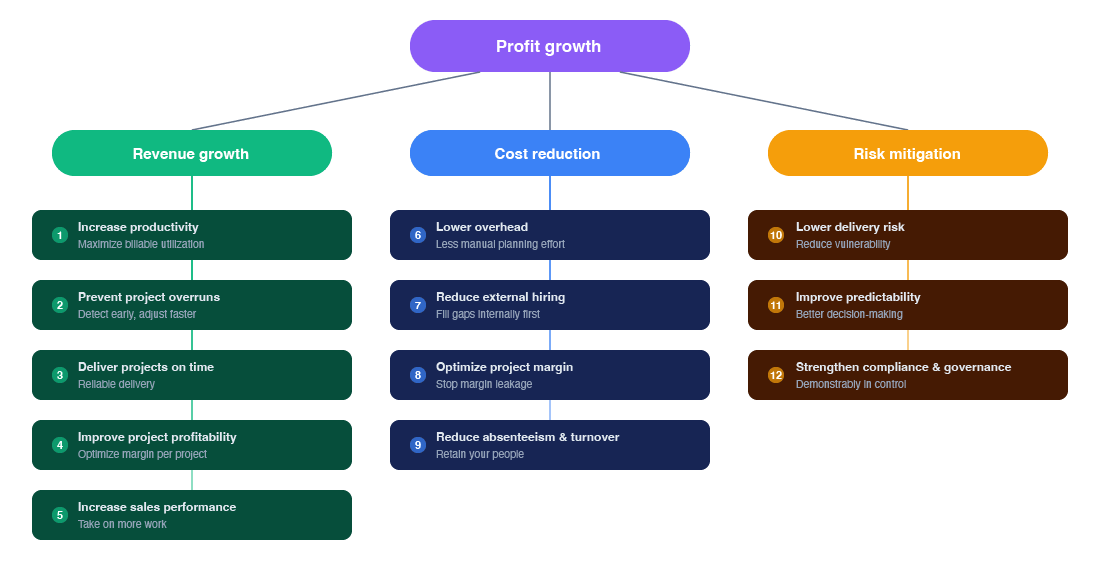
In this article, we’ll break down exactly how. We’ll use a value tree that illustrates the mechanisms through which better planning impacts your results—from the shop floor to the bottom line of your P&L.
The three pillars
Better resource planning contributes to profit growth in three ways:
- Revenue growth — you generate more revenue from the same customers.
- Cost reduction — you incur lower costs while maintaining the same output.
- Risk mitigation — You reduce the likelihood of costly setbacks.
That makes sense. But how exactly does it work? Let’s take a closer look at the specific mechanisms for each pillar.
Pillar 1: Revenue growth
Increase productivity (billability)
Billable hours are the key driver of revenue growth for service providers. For an agency with fifty employees, the difference between 65% and 75% billable hours can easily amount to hundreds of thousands of euros per year. But you don’t achieve that improvement by working harder—you achieve it by planning smarter.
It starts with matching supply and demand. Who will be sitting on the bench next week? Which project will need extra capacity in two weeks? If those two pieces of information aren’t in the same system, time is wasted. Every day that a consultant remains idle while there’s a gap elsewhere directly costs revenue.
A second source of lost productivity is context switching. Employees working on three or four projects at the same time lose up to 20% of their effective time switching between tasks. A schedule that deliberately promotes focus—longer blocks of time per project, fewer parallel assignments—yields measurably higher output.
And then there’s the downtime between project phases. When phase A of a project is complete, but the resources for phase B won’t be available for another two weeks, both the project and the employees come to a standstill. A schedule that accounts for dependencies between phases prevents these gaps.
Finally, competency-based planning makes all the difference. It’s not just about who’s available, but whether that person has the right competencies. Assigning the wrong resource to a project costs more than the delay you’d incur by waiting a little while for the right person.
Prevent project overruns
A project that goes off track almost always results in overtime. Do you work on a fixed-price basis? Then those extra hours will eat into your revenue. The sooner you identify deviations, the better your chances of making adjustments in time and staying within budget.
The key: continuously compare your actual progress with your original plan. Don’t wait until the end of the month—do it weekly or even daily. If you see that a project has already used up 75% of its budget after 60% of the project duration, you can make adjustments. Without that insight, you won’t notice the overspend until it’s too late.
The same applies to changes in scope. In practice, these are often handled informally: “We’ll just take care of that on the side.” But if that extra effort isn’t reflected in capacity planning, it can lead, without anyone noticing, to overload elsewhere or delays in other projects—and thus to a shift in revenue.
Deliver projects on time
Late delivery costs money in several ways. Direct costs: extra effort required to make up for the delay. Indirect costs: damage to reputation, penalty clauses, and delays to the next project that requires the same resources.
The problem is often not a lack of capacity, but a lack of visibility into capacity. Schedules based on nominal availability—40 hours per week, without taking into account time off, sick leave, part-time contracts, and internal obligations—are, by definition, too optimistic. Plan based on actual availability, and your schedule will be more realistic.
It also helps to identify bottleneck resources early on. If one senior architect is on the critical path for three projects, that’s a risk you want to see now—not next month.
Improve project profitability
Not every hour yields the same profit margin. A project carried out entirely by senior staff may be completed faster, but the profit margin per hour is lower than when you use a smart mix of senior and junior staff. Effective planning makes that trade-off clear.
In addition, the distinction between billable and non-billable hours is crucial. Project hours spent internally on knowledge development, rework, or internal coordination are necessary, but they eat into your margin if you don’t manage them carefully. And finally: manage based on actual rates, not just planned ones. If you consistently fall below the planned rate because you’re deploying more expensive staff than budgeted, that’s a structural problem you need to resolve in your planning.
Increase sales performance
This is perhaps the most underestimated point. How many projects have you turned down—or quoted with an unreasonably long turnaround time—over the past year, simply because you didn’t know what you could deliver?
A scheduling system that provides real-time insight into future availability enables the sales team to respond more quickly and reliably to potential orders. The time it takes to start new projects decreases, because you don’t have to wait until after the contract is signed to figure out who’s available. And you can take on more work, because you won’t have to turn down orders out of an abundance of caution when, in reality, you have the capacity to handle them.
Aligning the order pipeline with capacity is one of the greatest sources of effective revenue growth for project-based organizations.
Pillar 2: Cost reduction
Lower overhead
How many hours a week do your project managers and team leads spend trying to figure out the schedule? In many organizations, that number is alarmingly high. Manual scheduling in Excel, endless rounds of coordination via email, and weekly planning meetings that mainly focus on synchronizing information that should have been in a single system long ago.
A shared, up-to-date schedule—a single source of truth—drastically reduces that overhead. Not because there’s no longer a need for coordination, but because coordination focuses on decisions rather than data.
Reduce external hiring
Hiring external staff is the most expensive way to fill capacity gaps. Yet many organizations resort to it instinctively, simply because they realize too late that a shortage is coming.
With a more forward-looking plan, alternatives emerge. Can you fill the gap internally by reallocating projects? Can you start a hiring process in time that’s more cost-effective than hiring an external candidate for three months? You can only answer those questions if you identify the shortage months in advance, not weeks.
And if you do decide to hire outside help, make sure to clearly break down the costs by project. That forces you to carefully weigh the options: Is the margin on this project still acceptable given the external rates?
Optimize project margin
Write-offs are the silent margin killer. These are hours that were worked but not billed because the project is already over budget and you don’t want to damage the client relationship. In many organizations, these write-offs amount to 5 to 10% of revenue.
The solution isn’t to never make write-offs again, but to anticipate them. When you realize halfway through a project that you’re on track to go over budget, you can discuss additional work with the client—instead of absorbing the cost afterward.
Unintentional overtime is a related source of costs. Employees who consistently work more hours than planned not only generate additional labor costs but also incur a fatigue premium that later manifests as absenteeism and turnover.
Reduce absenteeism and turnover
This point is rarely mentioned in the context of resource planning, but its impact is significant. An employee who is chronically overworked—scheduled week after week at 110% or more—will eventually burn out. The costs of burnout are enormous: long-term absenteeism, replacement costs, and loss of knowledge.
A schedule that balances the workload identifies overburden before it becomes a problem—not as an HR tool, but as an operational management tool. And the indirect benefit is just as significant: employees who feel that the workload is distributed fairly and that their schedule is predictable are more likely to stay longer. In a tight labor market, that may well be the most valuable benefit of good scheduling.
Pillar 3: Risk mitigation
Lower delivery risk
Every project organization has key personnel. That one solution architect who is on the critical path for four projects. That one engineer who is the only one who has mastered a certain technology. As long as that remains hidden, it’s a time bomb under your delivery.
Resource planning makes those dependencies explicit. Who are your single points of failure? What happens if that person is out for two weeks? Scenario planning—what-if analyses of your staffing—transforms that risk from a vague concern into a concrete, manageable situation. And by consciously fostering skill overlap within teams, you build resilience without requiring additional capacity.
Improve predictability
How many of your strategic decisions are based on a gut feeling? “I think we can handle that project.” “I think we’re going to run into a problem in Q4.” That assessment is sometimes correct, but not always.
A planning tool that brings together the pipeline, capacity, and staffing in a single view gives your management team the data it needs to make better decisions. Go or no-go on a new project? Check the capacity data. Should we hire, or can we reallocate existing staff? Look at the forecast. Those decisions don’t get better with more meetings—they get better with better data.
And by analyzing historical planning data—how accurate were our estimates, where did projects consistently run over schedule—you can systematically improve your forecasts over time.
Strengthen compliance and governance
For organizations operating in regulated environments—such as engineering, maritime, or government projects—compliance in resource allocation is not a luxury but a requirement. Is this engineer authorized to approve drawings independently? Does this consultant have the required certification?
By factoring these requirements into your planning, you can avoid having to make corrections later on—or worse, discovering a compliance issue during an audit. An audit trail of plan changes also provides verifiable evidence of who made which decisions and when.
The big picture
What the value tree shows is that resource planning is not just an operational detail. It is a strategic tool that contributes to your profits through twelve specific mechanisms. Some of these—such as billability and preventing cost overruns—are direct and measurable. Others—such as increasing your commercial clout or reducing employee turnover—are more indirect, but no less valuable.
The difference between organizations that benefit from this and those that struggle rarely lies in the realization that planning is important. It lies in the tools and discipline needed to actually put it into practice. Not in Excel. Not in the minds of your project managers. But in a system that shows everyone the same reality—and links that reality to the financial impact of your decisions.