It’s Tuesday morning. Sales enthusiastically reports that a major contract is in, starting in three weeks. You look at the schedule and see that the people you need are fully booked for the next two months. Everyone knows what follows: shuffling, negotiating, overtime, and eventually a start date that gets pushed back anyway.
The reflex is often: we need to plan further ahead. That’s half right. The real answer isn’t a single longer horizon, but several horizons side by side, each with its own goal, level of detail, and rhythm. In this blog, you’ll read which ones they are, how to determine what fits your organization, and how to make the move from reactive to proactive.
Do you recognize reactive planning?
Reactive planning means the schedule follows what happens, instead of helping you determine what is going to happen. It often creeps in unnoticed.
The symptoms
- You are mainly busy firefighting and shuffling this and next week’s schedule.
- Some people are structurally working overtime, while others are sitting on their hands at the same time.
- You say no to work you’d actually like to do, or you say yes and discover later that it doesn’t fit.
- Start dates and deadlines are regularly adjusted because the right people aren’t available.
- Recruitment or hiring only starts when the shortage is already being felt.
Why organizations get stuck in it
The most common reason is uncertainty: “we don’t know what’s coming in anyway, so why would we plan far ahead?” Additionally, the planning often lies with one person who has the overview in their head or in a spreadsheet. And there is usually no proper bridge between the sales pipeline and capacity: sales knows what’s coming, planning knows who is available, but those two views only come together once a contract is signed.
What it costs
Reactive planning costs money and energy. Bench time weighs down utilization and margins, while overtime and last-minute hiring make projects more expensive. Employees get frustrated by constantly shifting priorities. And customers notice it through delayed start dates and changing faces in the project.
Why “as far ahead as possible” isn’t the answer
If reactive planning is the problem, the solution seems simple: look further ahead. Yet that rarely works if you just extend the same way of planning into the future.
Detail and certainty decrease over time
For next week, you know exactly who is there, which tasks are ready, and what the customer expects. For three months out, you might at most know which projects are likely running and which roles are needed for them. For next year, you mainly know how much work you expect and what knowledge you need to have in-house. The further you look, the less detail you can reliably fill in.
The false security of an overly detailed long-term plan
Anyone who assigns tasks to individuals six months out is building a schedule that collapses at the first change. The maintenance then becomes so heavy that no one keeps up with it, and within a few weeks, it’s no longer accurate. That is worse than no planning at all, because decisions are made based on a picture that is no longer correct. The trick, therefore, is not planning further ahead, but choosing the right level of detail for every distance.
Three planning horizons that coexist
Proactive organizations work with multiple horizons simultaneously. Each horizon answers a different question, at a different level of detail, and is updated at a different rhythm. The terms below are guidelines; you can read which ones specifically fit you in the next chapter.
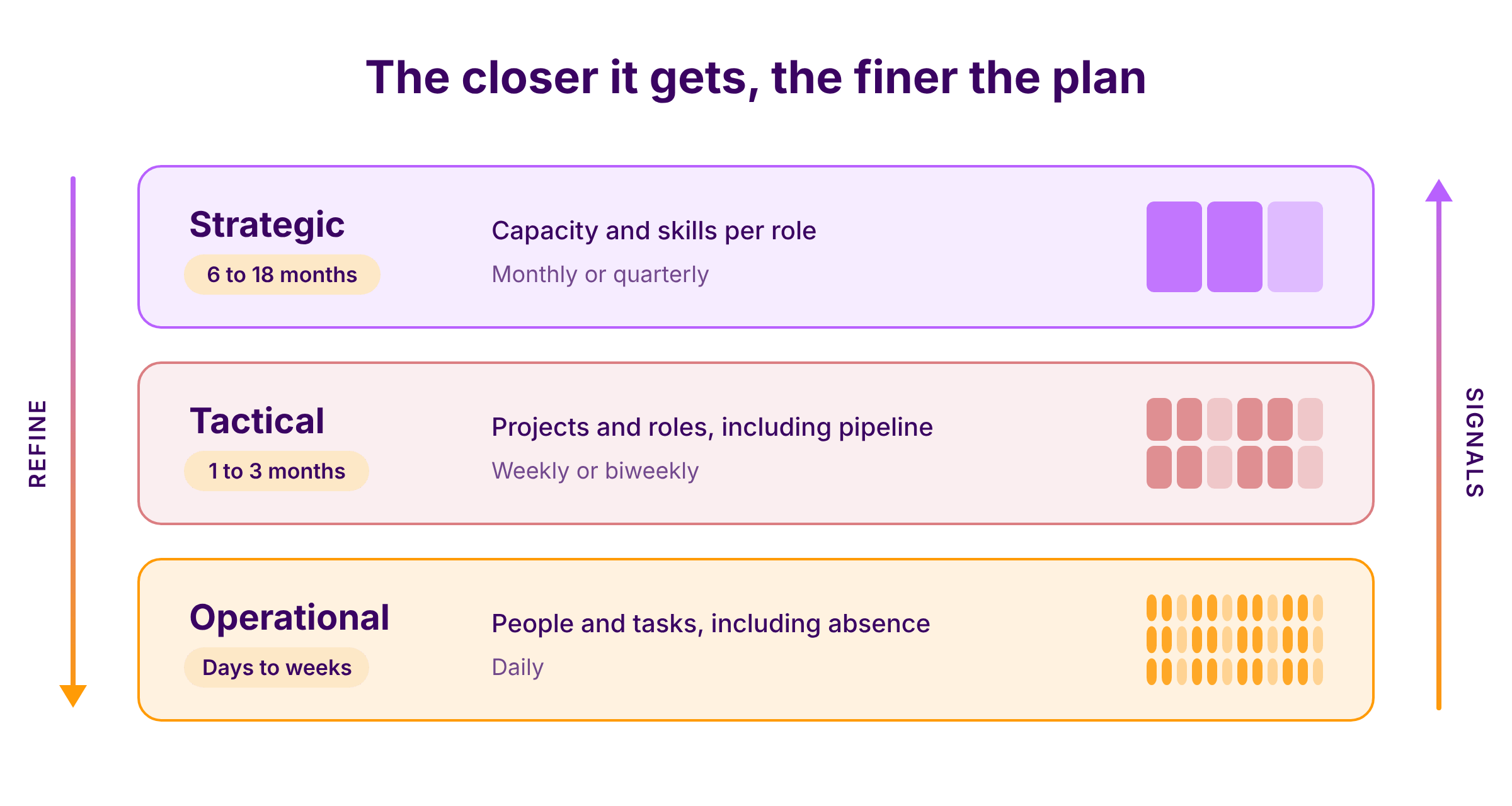 Figure 1: three planning horizons · from coarse to fine
Strategic (6 to 18 months): capacity and competencies
The question here is: will we have the right people, in the right numbers, with the right knowledge? You don’t plan by projects or individuals, but by total demand and total capacity per role or competency. Think of decisions about recruitment, training, building a flexible shell, or turning away work. You review this horizon once a month or per quarter.
Tactical (1 to 3 months): projects and roles
This is about the question: which projects are running, which are coming up, and which roles do they need? You plan at the project level and often by role or team, not always by name yet. Expected assignments from the pipeline also belong here, with an estimate of the probability that they will go through. You review this horizon weekly or bi-weekly.
Operational (days to weeks): people and tasks
This is the schedule everyone knows: who works on what and when. This is where detail belongs, including absences, leave, and daily shifts. This horizon is the most fluid and is updated daily or several times a week.
How the horizons connect
The horizons are not separate plans, but layers of the same picture. As a period gets closer, the coarse planning is filled in more finely: an expected demand for “three developers in Q2” becomes a project with roles, and then specific people on specific days.
The signals also travel the other way. If the operational schedule is structurally tight, that is information for the tactical and strategic layers. This prevents you from being surprised by the same shortage every quarter.
Which horizon fits your organization?
There is no universal answer to how far ahead you should plan. Four factors determine where your horizons lie.
Lead time and size of projects
Someone executing two-week projects needs a different tactical horizon than someone managing eighteen-month trajectories. A rule of thumb: your tactical horizon should be at least as long as the period between the moment a contract becomes likely and the moment it starts. Otherwise, you only see the work when it’s already at the door.
Predictability of demand
Organizations with a lot of recurring work, such as maintenance contracts or annual cycles, can estimate demand fairly well far in advance. Those who mainly get one-off, unexpected assignments work better with a shorter detail horizon and a deliberately planned buffer for what is yet to come.
Flexibility of your capacity
How quickly can you scale capacity up or down? If you easily deploy freelancers or partners, you can get by with a shorter strategic horizon. If you depend on scarce specialists whom you must recruit or train months in advance, your strategic horizon must align with that.
Differences by industry
The factors above lead to different choices per industry. A few examples:
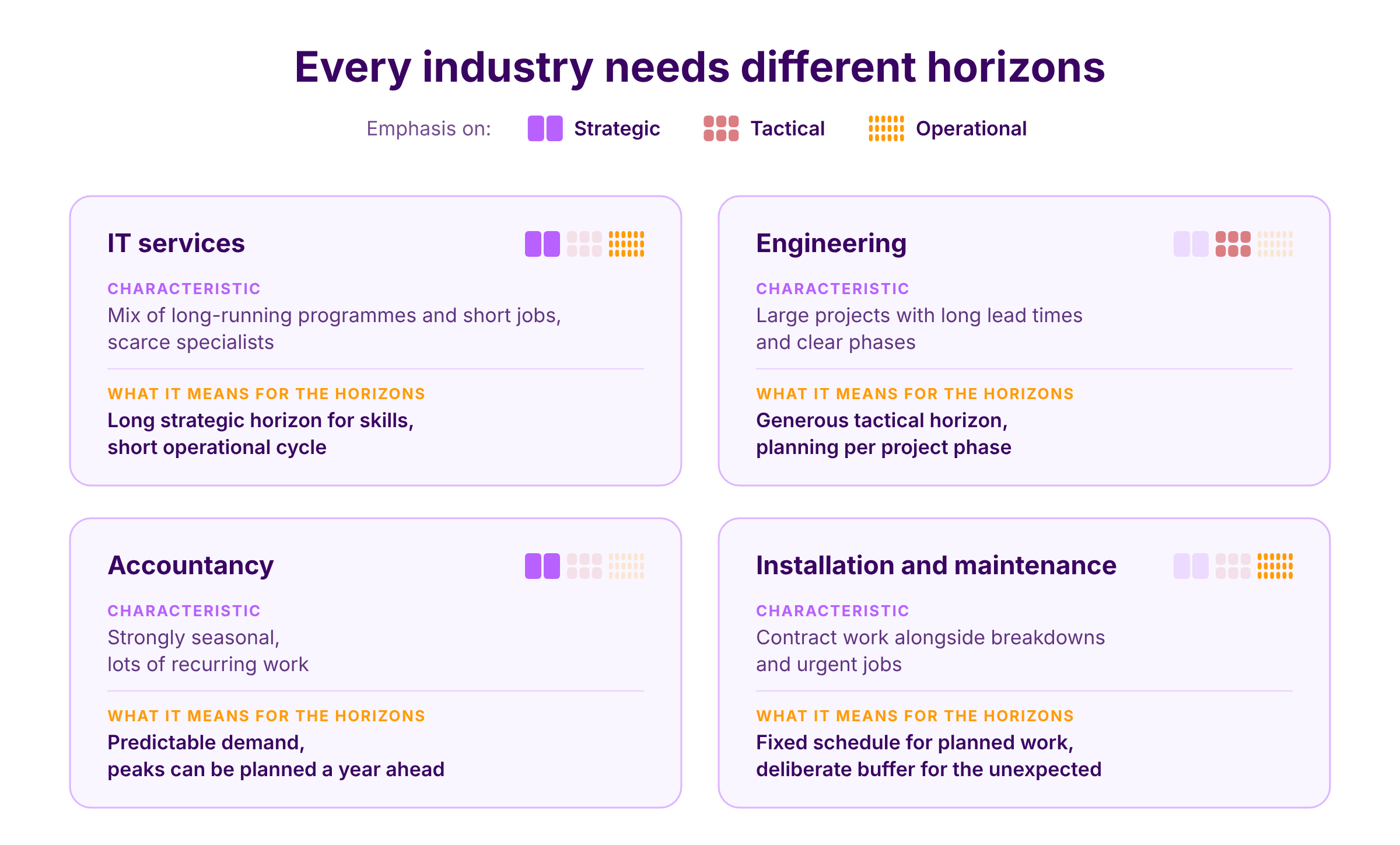
Figure 2: differences per industry
It pays to explicitly name which horizons you use for your own organization and why. That conversation alone often makes it clear where things are currently going wrong.
How to make the move to proactive planning
Moving from reactive to proactive doesn’t happen all at once. These five steps will help you on your way.
Start with visibility into the pipeline
The biggest gain is usually in connecting sales and planning. Include expected assignments in the schedule, with an estimate of the probability they will go through and the roles they require. This way, you see a shortage coming before the contract is signed, and you can make conscious choices: recruit, hire, propose a start date that actually fits, or put extra sales effort into a quiet period.
Work with a rolling schedule
A plan you draw up once a year is outdated after a month. Therefore, work with a rolling schedule: each period, the horizon moves up one step and you adjust based on what you know now. Link a fixed rhythm to that, for example, a weekly check on the tactical horizon and a monthly one on the strategic.
Plan coarse where possible and fine where necessary
Use the level of detail that fits each horizon. Far out, you plan in hours or days per role per month; closer in, in projects and teams; and only in the short term by name and task. That keeps the planning maintainable and avoids the false security of premature detail.
Make utilization and demand comparable
Proactive planning revolves around one comparison: how much work is coming and how much capacity do we have for it? Make that comparison per role or competency, not just for the organization as a whole. A team can have enough total capacity and still have a major shortage of one specific profile.
Establish ownership and consultation moments
Planning is not the task of one person, but a conversation between sales, project management, team leaders, and management. Agree on who monitors which horizon and when you look at it together. A short, fixed capacity meeting often works better than an extensive planning process that no one sticks to. We wrote about this earlier in the blog “A process for project and resource planning”.
Common mistakes
Wanting to plan everything down to the individual level
It feels thorough, but a long-term plan full of names and tasks is mostly a lot of work to maintain. Plan far ahead by role and capacity, and only fill in names when the moment is close enough.
A schedule that no one updates
A schedule is only valuable if it’s accurate. If updating it takes too much effort, people drop out and shadow schedules emerge in separate spreadsheets. Keep the process light and the rhythm steady.
Sales and planning working at cross purposes
If sales brings in contracts without visibility into capacity, and planning only hears about a contract once it’s signed, you remain reactive. Let both worlds look at the same picture, even for work that isn’t certain yet.
In conclusion
How far ahead you should plan depends on your projects, your demand, and the flexibility of your capacity. But the answer is never a single number. Proactive organizations combine a strategic horizon for capacity and competencies, a tactical one for projects and roles, and an operational one for people and tasks. They plan coarse where possible, fine where necessary, and keep the layers connected with a fixed rhythm.
The question to start with, therefore, is not “how far ahead do we look?”, but: which horizon are we currently missing?